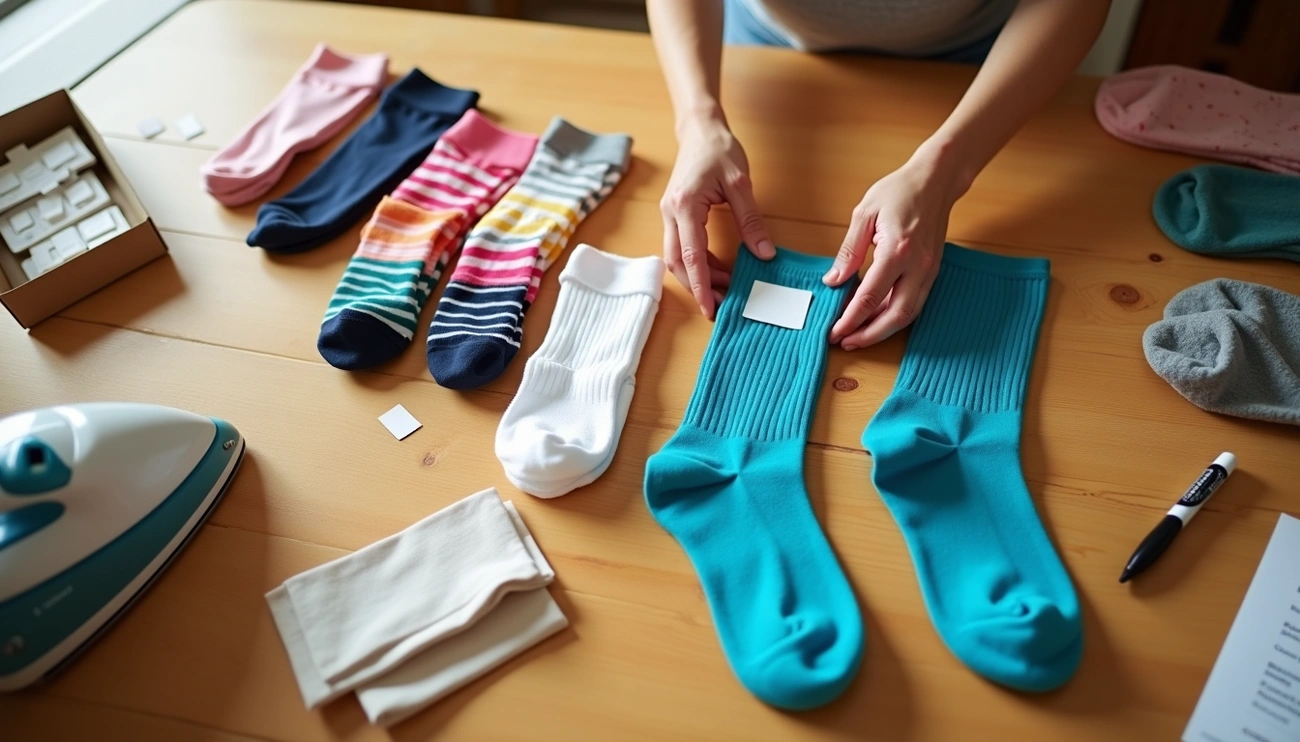
Label socks for camp by marking the sole or inner cuff with a fabric stamp, permanent marker, or iron-on label. Use quick-drying indelible ink so the name stays visible after washing and drying. Color-code pairs with small tags or marks to help campers quickly identify socks and prevent losses.
Why Socks Are the Hardest Camp Item to Label
Parents face a unique challenge when preparing kids for camp: figuring out how to label socks when everything about them seems designed to resist identification.
No Care Tags to Work With
Unlike shirts, pants, or jackets, socks don’t come with care tags sewn into the seams. Manufacturers typically print sizing information on cardboard packaging that gets tossed immediately. When care instructions do appear, they’re woven directly into the fabric rather than attached as a separate tag.
This creates a problem for standard name labels. Most stick-on clothing labels are designed to attach to existing care tags. Without that tag, parents must apply labels directly to stretchy sock fabric, which doesn’t always hold adhesive well. The printed size information on some socks provides a potential labeling spot, but many socks lack even this feature.
Stretchy Fabric Challenges
Sock fabric stretches with every step, creating constant stress on any label attached to it. This stretching motion works against adhesives, causing labels to peel at the edges. The problem intensifies with different sock materials. Cotton sports socks, woolen socks, and polyester dress socks all react differently to labeling methods.
Black socks present an additional obstacle. Permanent markers and laundry pens simply don’t show up on dark fabric. While a Sharpie might work temporarily on light-colored socks, the ink washes out eventually. Parents need specialized labeling solutions specifically for dark fabrics, adding another layer of complexity to what should be a simple task.
High Loss Rate at Camp
Camp counselors report seeing numerous single socks in lost and found bins after every session. Children remove their socks and shoes for swimming, sports, and various activities. Socks get kicked off during rest time, left in bathrooms, or accidentally mixed into someone else’s laundry pile.
The combination of frequent removal and lack of identifying marks makes sock recovery nearly impossible. When kids grab socks from a pile of similar-looking pairs, they can’t easily spot which ones belong to them. As a result, unlabeled socks end up abandoned in lost property, never making it back to their owners. Camp staff specifically recommend labeling everything, including socks, because so many items go unclaimed each summer.
This high loss rate makes learning how to label kids socks for camp essential for any parent sending children to sleepaway camp.
Best Label Types for Labeling Socks
Three main label types work for socks at camp, each with distinct advantages for different situations.
Iron-On Labels for Socks
Iron-on labels fuse directly to sock fabric during application and cannot be removed. These labels work on cotton, linen, and polyester socks, withstanding regular washing machine cycles and dryer heat. Small dot-style iron-on labels measure 1.5cm x 1.5cm, fitting perfectly on sock soles without creating bulk or discomfort.
The white background with black font makes names easily identifiable on both light and dark socks. Application requires placing the label on the sock sole, covering with parchment paper, and pressing with an iron set to the highest cotton setting. These labels are laundry-safe, fade-resistant, and heat-safe up to 220 degrees Fahrenheit.
Stick-On Labels for Socks
Stick-on labels attach in approximately 3 seconds, making them the quickest labeling option. However, they work best on existing care labels rather than directly on fabric. In light of this limitation, socks without care tags pose a challenge.
The adhesive quality determines longevity, and cheaper options may last only a couple of washes. Stick-on labels are not recommended for items going through regular washing.
Clothing Stamps for Socks
Clothing stamps come preloaded with laundry-safe ink lasting approximately 40 washes to 60 washes. Each stamp handles around 500 applications, with some managing thousands of impressions. The compact design works well for narrow sock cuffs and small clothing spaces.
For dark socks, white iron-on tape can be applied first, then stamped. The ink is non-toxic and water-resistant.
Which Label Type Works Best
Iron-on labels provide the most permanent solution for camp socks. Consequently, they’re the best choice for tagless clothing items like socks and towels. Stamps offer convenience but require reapplication throughout the season, while stick-on labels lack the durability needed for camp’s washing conditions.
How to Label Socks for Camp Step-by-Step
Preparing Your Socks for Labels
Wash socks before applying any labels. Clean fabric allows adhesives to bond properly. Lay the sock flat on a hard surface like an ironing board. For iron-on labels, preheat the fabric for a few seconds with your iron to remove wrinkles and moisture.
Applying Iron-On Labels to Socks
Place the label lengthwise on the sock sole, running from toe to heel under the arch. This area experiences minimal rubbing, allowing labels to adhere longer. Set your iron between 140-170°C, approximately the cotton setting. Turn off the steam function and let the iron reach temperature.
Position the label face up on the sole. Cover it with baking paper to protect delicate fabrics[151][171]. Press the hot iron firmly onto the baking paper for 15 seconds without moving it. Lift the iron, then press hard again. Repeat this process three times for a total of 15 seconds of heat application. The label should nearly blend into the fabric texture when properly applied.
Applying Stick-On Labels to Socks
Press stick-on labels firmly onto the sock fabric, squeezing for several moments to activate the adhesive. These labels work best as a temporary solution since they eventually peel off through washing.
How to Label Black Socks for Camp
Black socks require labels with white backgrounds and black font so names remain visible[141][151][171]. Standard iron-on labels work well on dark fabric without requiring special techniques.
Labeling Different Sock Types
Short sports socks and ankle socks should be labeled on the sole as described above[151][171]. For knee-high socks that fold down, alternatively place the label on the outside near the top[141][151][171]. When folded, the label sits underneath the fold, protected from friction during walking.
Making Your Sock Labels Last All Summer
Wait Before Washing Labeled Socks
Moisture interferes with the bonding process of clothing labels. Once you’ve applied labels to your socks, resist the urge to wash them immediately. Allow at least 24 hours for iron-on labels to cure completely. During this waiting period, the adhesive forms a permanent bond with the fabric fibers.
Make sure your socks are bone dry before applying any labels in the first place. Running them through an extra dryer cycle ensures no hidden moisture remains in the fabric, which would prevent proper adhesion.
Washing and Drying Tips
Turn socks inside out before washing to reduce friction and preserve the label’s appearance. Cold water prevents shrinkage and protects both the sock fabric and label adhesive. Use mild detergent without bleach, as harsh chemicals weaken fibers and can damage label adhesion.
Air dry your socks whenever possible by hanging them or laying them flat. If using a dryer, select low or delicate heat settings to prevent excessive wear. High temperatures break down adhesives and cause labels to lift at the edges.
What to Do If Labels Start Peeling
Check peeling labels immediately after noticing them. Press the label back down while the sock is still warm from the dryer. For iron-on labels that have partially lifted, place parchment paper over the label and reapply heat with your iron for 10-15 seconds.
Conclusion
You now have everything you need to keep those socks from disappearing at camp. Iron-on labels offer the most reliable solution, especially when applied correctly to the sock sole and given proper curing time. Remember, the key to successful sock labeling is choosing the right method and following care instructions carefully. Take the time to label every pair before camp starts, and you’ll save yourself the hassle of replacing lost socks all summer long.