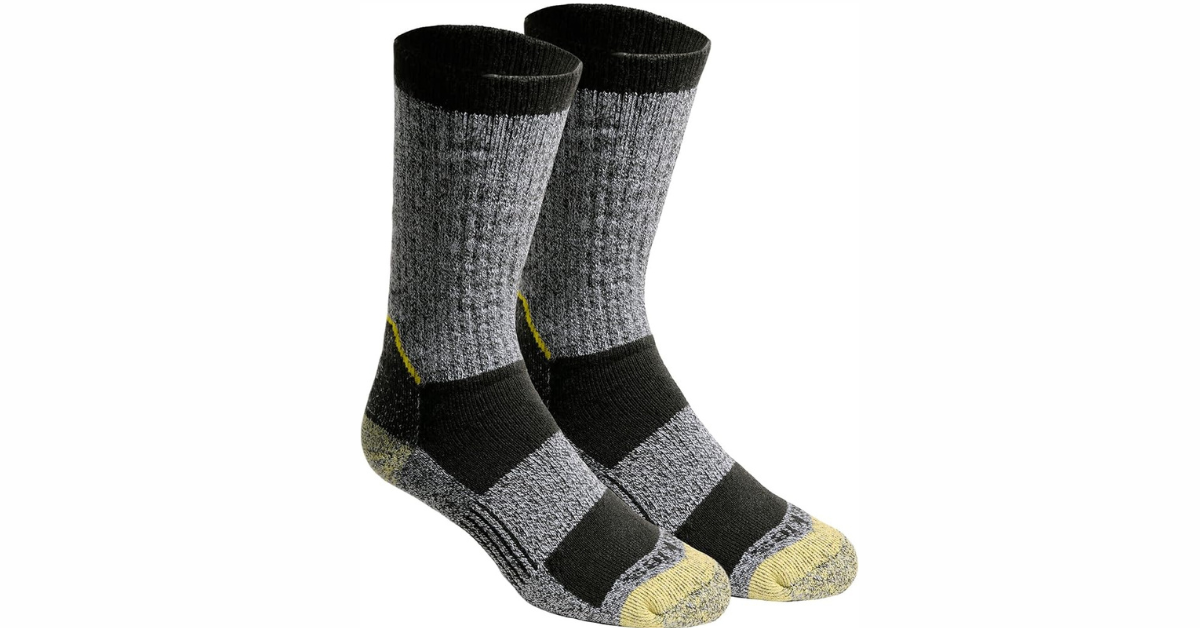
Dickies socks are made from a durable blend of cotton, polyester, nylon, and spandex. Material ratios vary by style, such as Dri-Tech, Thermal, or Steel Toe, to deliver moisture control, cushioning, and long-lasting wear. Reinforced heels, toes, and built-in arch support improve comfort for work and everyday use.
What Makes Dickies Socks Different
Dickies stands apart in the work sock landscape through a century of experience focused on three core principles: durability, comfort, and function. First of all, these aren’t typical footwear accessories – they represent purpose-built tools for hardworking people.
Built for work, not just wear
Unlike fashion-oriented socks, Dickies creates products specifically engineered for demanding work environments. As a matter of fact, these socks are built for people who “move, sweat, grind and still need comfort when the shift’s done”. What truly sets them apart is their job-specific engineering:
- Reinforced Heels & Toes: Every high-stress zone receives extra reinforcement, extending their lifespan significantly
- Arch Compression: This feature keeps socks firmly in place, preventing slipping or bunching during long shifts
- Strategic Cushioning: Delivers softness while effectively handling impact
- Moisture Control: Advanced fibers wick away sweat more efficiently than standard cotton
The difference becomes evident after extended wear. Indeed, most conventional socks flatten after a few washes, but Dickies’ dense knit maintains cushioning springiness even after months of regular use. For workers spending 10+ hours daily on their feet, this distinction becomes crucial – ordinary socks simply deteriorate too quickly under such conditions.
Real-world testing and feedback
Consequently, Dickies doesn’t design socks in isolation – they’re field-tested by actual workers who “live in boots, not sneakers”. This real-world approach explains their consistent 4+ star ratings across multiple platforms. Their Dri-Tech Crew Work Socks, for example, maintain a 4.2 overall rating from 285 customer reviews.
Customer testimonials further validate their performance advantages. One reviewer noted, “They feel great – soft, cushioned” and “washing doesn’t seem to shrink them”. Another mentioned the socks are “great with prompt shipping” and “wear forever”.
However, not all feedback is positive. Some customers have noticed changes in quality over time, with one noting that more recent purchases had “thinner material and no longer has the reinforced heel”. This transparent mix of feedback demonstrates the real-world testing that informs Dickies’ ongoing product development.
Who makes Dickies socks?
Dickies socks emerge from a company with over 100 years of workwear manufacturing experience. The brand focuses exclusively on creating “hard-duty work products built to stand up to whatever life throws at you”. Their commitment to quality has established them as the “#1 Selling Men’s Work Sock in the USA” according to retail tracking data.
Above all, what separates Dickies from competitors is their positioning in the market. They occupy the “sweet spot between cheap multipacks and premium performance brands”. For budget-conscious workers seeking value, the Dickies Dri-Tech Crew 6-Pack offers exceptional cost efficiency at under $3.00 per pair.
In the realm of work footwear, this balance of affordability and performance creates a distinct advantage. Rather than forcing workers to choose between disposable cheap socks or expensive specialty brands, Dickies provides a middle ground – durable enough for serious work but accessible for everyday budgets.
Material Breakdown: What Are Dickies Socks Made Of?
The foundation of any quality sock lies in its material composition. Diving deep into what are Dickies socks made of reveals a carefully engineered blend designed for specific work environments. Each material serves a distinct purpose, creating socks that perform under pressure.
Cotton: Softness and breathability
Cotton forms the core of most Dickies socks, providing the softness workers need during long shifts. Depending on the sock style, cotton content varies substantially—from 41% in some black Dri-Tech crews to as high as 77% in certain Dri-Tech Essential models. This natural fiber excels at comfort while allowing air circulation around the foot. Primarily, cotton gives these socks their initial soft feel against skin but works best when blended with performance fibers.
Polyester: Strength and moisture control
Polyester stands as the workhorse ingredient in Dickies socks, comprising between 19-53% of the material composition. This synthetic fiber delivers two critical benefits: structural integrity and moisture management. Moreover, polyester creates the foundation for Dickies’ moisture-wicking technology, which pulls sweat away from skin. In white Dri-Tech crews, polyester constitutes 53% of the composition, making them particularly effective for hot environments where sweat control matters most.
Acrylic: Warmth and durability
For specialized work conditions requiring extra warmth and resilience, Dickies incorporates acrylic fiber. Notably, their Steel Toe Work Socks contain 76% acrylic, providing insulation and cushioning against rigid safety footwear. Thermal models also utilize acrylic blends to trap body heat while maintaining durability. The fiber’s structure creates microscopic air pockets that retain warmth without excessive weight—essential for cold-weather construction or refrigerated warehouse environments.
Nylon: Flexibility and airflow
Though present in smaller percentages (typically 1-9%), nylon plays a crucial role in maintaining sock structure. This fiber enhances elasticity while simultaneously improving airflow through engineered ventilation channels. Naturally, the addition of nylon extends sock lifespan by resisting abrasion in high-friction areas. Steel Toe Work Socks incorporate 9% nylon to withstand the constant friction against protective footwear.
Spandex: Stretch and fit
To clarify, practically all Dickies socks contain a small but vital percentage of spandex (sometimes labeled as Lycra® Spandex)—consistently 1-2% across all styles[122]. This elastic fiber ensures socks maintain their shape throughout the workday. The modest amount delivers just enough stretch without compromising durability or creating uncomfortable compression. Particularly in arch support zones, spandex provides the tension needed to keep socks properly positioned.
Wool: Natural insulation for cold weather
For extreme cold environments, Dickies incorporates wool into specialized thermal socks. Their heavyweight thermal options contain approximately 19% wool, delivering superior warmth with natural moisture management. Comparatively, synthetic-only socks can’t match wool’s temperature regulation capabilities in freezing conditions. Essentially, wool fibers trap warm air close to skin while simultaneously wicking away sweat that would otherwise cool and chill the foot.
What makes Dickies socks truly remarkable isn’t just the materials themselves but their precise proportioning for specific work demands. Black Dri-Tech crews contain 75% cotton for comfort with 19% polyester for durability, while thermal options prioritize insulation with wool and acrylic blends. This deliberate engineering explains why different Dickies socks feel and perform uniquely based on their intended purpose.
Specialty Materials in Select Dickies Socks
Beyond standard materials, Dickies produces specialized socks featuring advanced fibers designed for extreme working conditions. These high-performance options deliver protection and durability far exceeding conventional work socks.
Kevlar: Extreme durability in high-friction zones
For demanding environments, Dickies incorporates DuPont™ KEVLAR® fiber—the same material used in bullet-resistant vests. This remarkable aramid fiber makes these specialty socks 32 times more durable than leading competitors’ work socks. The material composition typically includes:
- 81% Polyester
- 11% Nylon
- 6% Aramid (Kevlar)
- 2% Spandex
This engineered combination creates extraordinary abrasion resistance, primarily in high-wear areas like heels and toes. The reinforced zones stand up to constant friction against work boots without deteriorating.
What are Dickies Kevlar socks used for?
First of all, Dickies Kevlar socks serve as protective equipment for workers facing potential foot injuries. In a biomechanical study using human cadaver limbs, researchers found that none of the achilles tendons (0/7) were lacerated when protected with Kevlar® reinforced socks, whereas all tendons (7/7) tested with standard synthetic socks were completely severed.
Furthermore, these specialized socks withstand significantly greater impact forces. The testing revealed peak force resistance of 4030 ± 1191 N versus 2037 ± 729 N for standard socks. This makes them ideal for:
- Construction sites with sharp debris
- Manufacturing environments with metal shavings
- Hockey and ice sports (preventing skate blade injuries)
- Intense outdoor work requiring maximum durability
Thermal blends for cold environments
In cold weather situations, Dickies offers thermal wool-blend socks that balance warmth with durability. These specialized socks typically contain a mixture of polyester, wool, nylon, acrylic, and spandex. The wool-blend thermal construction provides natural insulation while maintaining breathability.
Subsequently, these thermal options include full cushioning throughout the foot and leg, offering impact protection and warmth simultaneously. The reinforced heel and toe construction extends durability in these critical wear points even in harsh conditions.
Mesh ventilation in moisture-control socks
Finally, Dickies employs strategic mesh ventilation in their moisture-control sock designs. This engineering approach creates channels that improve airflow and breathability, keeping feet cooler and drier. Their Dri-Tech moisture management technology actively wicks perspiration away from the skin.
The ventilation system pairs with moisture-wicking fibers to create a comprehensive sweat management system. This technology has helped establish Dickies Dri-Tech Crew as the #1 Selling Men’s Work Sock in the USA.
What truly sets these specialty materials apart is how they complement the base materials discussed earlier. While standard materials handle everyday conditions, these advanced fibers tackle extreme environments where ordinary socks would quickly fail.
What Are Dickies Dri-Tech Socks Made Of?
Dri-Tech represents Dickies’ flagship sock line, earning recognition as the “#1 Selling Work Sock in America”. These performance socks stand out for their specific material engineering tailored to address workplace moisture challenges.
Material composition of Dri-Tech socks
Examining what are Dickies Dri-Tech socks made of reveals varying compositions across different models and styles. The standard men’s Dri-Tech crew socks feature:
- 78% Cotton/19% Polyester/2% Spandex/1% Nylon
Yet, in women’s Dri-Tech Advanced Moisture-Wicking models, the composition shifts dramatically to:
- 96% Polyester, 2% Spandex, 2% Nylon
This material difference highlights how Dickies tailors compositions for specific applications—prioritizing softness and breathability in men’s work models while maximizing moisture control in women’s athletic-oriented designs.
How moisture-wicking fibers work
Primarily, Dri-Tech socks employ specialized moisture control fibers that actively pull perspiration away from skin. This technology doesn’t merely absorb sweat—it transports it to the sock’s outer surface for faster evaporation.
What sets these socks apart from ordinary cotton options is their engineered ventilation channels. These strategic pathways enhance air circulation throughout the sock structure. To begin with, the fibers capture moisture at the skin surface. Next, capillary action draws the moisture outward through specially designed channels. Finally, the evaporation process completes the moisture management cycle.
First and foremost, this system maintains drier feet throughout extended work periods. The full cushion foot design complements this moisture management by providing comfort without compromising breathability.
Ideal use cases for Dri-Tech socks
Dri-Tech socks excel in environments where moisture control directly impacts comfort and foot health:
- Long work shifts: The arch compression prevents sock migration during extended movement
- High-temperature workplaces: Ventilation channels provide crucial cooling effects
- Safety footwear environments: Reinforced heels and toes stand up to friction from work boots
- Active work settings: Moisture-wicking technology helps prevent blisters during constant movement
In fact, the durability features—including reinforced heels and toes—make these particularly suitable for construction, warehouse, and industrial applications where ordinary socks quickly deteriorate.
As shown by their market position, Dri-Tech socks fill the essential niche between basic cotton socks that quickly become soggy and expensive specialty performance socks, making them the practical choice for everyday work wear.
How Materials Impact Performance and Comfort
The material composition of Dickies socks directly translates to noticeable performance differences in demanding work environments. As such, understanding how these carefully selected fibers interact creates a clearer picture of why professional workers consistently choose these specialized socks.
Cushioning and shock absorption
The high-density materials in Dickies work socks deliver cushioning that genuinely lasts. Primarily, their dense knit construction prevents the cushioning from flattening out after repeated washing—a common problem with standard socks. This consistent cushioning creates persistent shock absorption throughout the sock’s lifespan, hence protecting feet during extended standing or walking.
First, the heavyweight full-cushion comfort extends through both leg and foot areas. This design distributes pressure evenly, reducing fatigue during long shifts. Despite repeated use, the carefully engineered material density maintains its springy resistance, continuing to protect feet from impact stress.
Reinforced heels and toes
Dickies strategically reinforces high-stress zones with additional material thickness. Currently, their approach involves using a heavier count of yarn specifically in impact areas—heel, toe, and pad—for superior durability. This engineering approach, not merely marketing language, results in socks that withstand significantly more wear than standard options.
The reinforcement technique varies by model; therefore, some specialty lines provide extended reinforcement through the toe cap specifically for steel toe protection. This targeted reinforcement demonstrates what are Dickies socks made of in critical wear points.
Compression and arch support
The material blend creates precise compression zones that maintain sock position. Naturally, the arch compression design provides support without restricting circulation. This compression fit locks socks in place, preventing the common workplace problems of slipping, bunching, or sagging.
In addition to arch compression, many models include ribbed cuffs that secure the sock without creating uncomfortable pressure points. By comparison with standard socks, this engineering approach maintains proper positioning throughout active movement.
Temperature regulation
The thick combed cotton in many Dickies models actively regulates foot temperature—keeping feet warm in cold conditions yet cool in heat. This natural temperature control works alongside moisture management fibers to maintain optimal comfort regardless of external conditions.
Several specialty models incorporate advanced temperature-regulating technology through their material composition. At the same time, these innovative socks utilize moisture-wicking technology to maintain optimal temperature and dryness. The combination creates a microclimate around the foot that adjusts to changing work conditions throughout the day.
Conclusion
Dickies socks stand apart from ordinary footwear through their purposeful material engineering. Throughout this guide, we’ve seen how each component—from cotton and polyester to specialized fibers like Kevlar—serves a specific function. Cotton delivers softness, polyester provides strength, while nylon, spandex, and acrylic add flexibility, stretch, and warmth respectively.
The science behind these material combinations explains why Dickies has earned its position as America’s #1 selling work sock. Their Dri-Tech technology actively wicks moisture away from feet, though different models contain varying percentages of materials based on their intended use. Steel toe variants, for instance, prioritize durability with higher acrylic content, whereas thermal options incorporate wool for natural insulation.